Thursday, November 11, 2010

Leek and Portobello Frittata with Thyme and Oregonzola

Leeks have become a real favorite of mine, and were frequently available at the farmer's markets this summer.  The other night, I realized that my garden thyme was still producing, there was a hunk of Oregonzola cheese in the fridge, and I had two local leeks and a portobello mushroom.  The planets aligned, and this dish was born.  A classic combination of great savory flavors.
 _______________________________________________
 LEEK AND PORTOBELLO FRITTATA WITH THYME AND OREGONZOLA

2 tablespoons butter
2 leeks, white and light green parts only, sliced thinly
1 big 'ol portobello mushroom, stem removed and cut in 1/4-inch slices

1 clove garlic, chopped
1 tablespoon fresh thyme leaves or 1 teaspoon dried

6 to 8 local, free-range eggs, beaten
Salt and pepper

1 tablespoon crumbled Oregonzola cheese

In frittata pan or medium-sized ovenproof skillet, melt the butter over medium heat.  Saute the leeks just until they become somewhat soft.  Add the mushroom slices, and carefully saute for a few minutes or until the mushrooms have become somewhat soft.  Push the leeks around to cover the bottom of the skillet, and bring the mushroom slices to the top.  You can arrange them in a starburst design if you wish.  Scatter a little salt and pepper over all, then carefully pour on the eggs to fill the pan.  Lift up the mushrooms if any become covered with eggs.  Scatter garlic and thyme leaves over all.  Continue cooking on stovetop for a couple of minutes or until eggs begin to set.

Place pan in oven and bake for 5 to 10 minutes or until eggs are just set.  Watch carefully; you don't want the frittata to be too dry.

Remove from oven, wrap potholders around handles so no one gets burned, and scatter the cheese across the top.  Cut with spatula into wedges.  Serve hot.

Makes 6 to 8 servings

Monday, November 8, 2010

A Year of Blogging Local

Today my humble blog celebrates its first birthday.

You, dear reader, have really made my blogging year a true pleasure.  You have shared recipes, given advice, actually made some of my recipes (this one was the most popular), and some even showed up at my house for a class.  You have commented.  You have endured my bad photographs.   You have happily accepted containers of leftover blogged dishes, and in some cases sat down at the initial taste testings.   You have been unflinchingly honest.  You have come into my kitchen and cooked with me

One cannot cook with local foods without ... local foods.  I am constantly thankful for our many local farmers' markets, growers and producers, and especially for the indispensable gift of our local Winter CSA, happening again this winter.

This recipe was in the works last winter when we lost my Dad.  The comfort of robust, home-cooked food at a time like that cannot be overstated.  I am thankful for my family and friends, and give special accolades to my mom, whose influence on my life with food has for years nourished not only my love of the fresh and local bounty around us, but my creativity and spirit of fun in cooking and trying new things.

Thank you, every one.

Saturday, November 6, 2010

Save the Pickled Beets!

Sometimes, but not so much lately, I worry about foods disappearing.  I know, some foods should disappear, like fried liver and doorstop fruitcakes.  But you know what I mean:  You're savoring a lovely slice of spicy pickled beet and suddenly, without warning, you think, "What if people stopped eating beets?  And farmers stopped growing beets?  And there would be no more pickled beets!"

I'm not saying everyone has episodes of food paranoia like me, but in case the whole worrying-about-food-disappearing thing is due to the cosmic resonance of some underlying potential universal truth, now and again I like to make, and enjoy, pickled beets. And if you do it, too, maybe we'll keep pickled beets alive!
____________________________________________
PICKLED BEETS

This recipe is easily increased for more beets, and all the ingredients can be played around with according to your taste.  Makes about a quart.  If you put striped or golden beets in with red ones, the whole mixture will be more or less red!

About 6 medium-sized beets, or 12 smaller ones, either red, gold, striped, or a mix
2/3 cup cider vinegar
1 or 2 tablespoons agave nectar or organic sugar (I sometimes use apple juice concentrate)
1/2 teaspoon salt
1 tablespoon horseradish
1/4 teaspoon ground cloves
A few grinds of black pepper

Wash the beets and either trim the stalks off or leave an inch or so on.  Lay beets on an aluminum foil-covered pan and roast at 350 degrees for an hour or so.  If beets are varying sizes, some may need to be removed before others are done.  Beets should be tender when pierced with a knife.

Alternatively, wrap the beets in aluminum foil and roast for the same amount of time.

Alternatively again, boil the beets in a big kettle of water until they are tender when pierced with a knife.  This is the method I use most often, because the beets peel more easily than they do when roasted.

Cool the beets, and trim off the stems and root ends and any weird spots.  Rub the peelings off (a paper towel works nicely for this) and cut the beets into your preferred shapes ... slices, dices, you call it.  Toss them into a quart jar.  You can have the vinegar and spice mixture already in the jar, or you can toss it in on top of the beets and shake gently.  Store in fridge, turning and tossing jar gently now and then to keep the beets coated in the pickly mixture.  They'll be pickled in about a week. Enjoy without fear.

Wednesday, November 3, 2010

Beet and Saffron Rice Timbale with Spinach and Leeks

Ms. Eating the Scenery is smitten.  She stumbled across this chef who, apparently, has been cooking in England for some time without Ms. Eating the Scenery's knowledge.  What a funny name he has!  And how creative are his culinary combinations!  Quinoa and fennel salad with mint, coriander and dill!  Lentils, radiccho and walnuts with manuka honey! 

Ms. Eating the Scenery is the devoted slave of anyone who can find new and tasty, nay, soaringly scrumptious dishes using vegetables, herbs, grains, nuts, legumes in simple yet magical ways! 

Even Ottolenghi's recipes, however, are but a starting point.  Inspiring, but endlessly revisable.  Which of course all truly great recipes are.  Ms. Eating the Scenery's addition of leeks to the sauteed spinach, she thinks, elevated this dish to truly splendid.  Her sidestepping of several of the more fussy steps resulted in a different looking dish than Ottolenghi's, but it satisfied on every level of taste.

Next time, Ms. Eating the Scenery will consider assembling this dish in a glass casserole in reverse order, so that it looks neat and contained, showing off its colorful layers.  
_________________________________________________
BEET AND SAFFRON RICE TIMBALE
WITH SPINACH AND LEEKS
Adapted from Yotam Ottolenghi

3/4 teaspoon saffron threads
1/4 cup boiling water

3 medium beets (but roast a few more while you're at it, for pickled beets)
2 teaspoons olive oil
Salt and pepper

2 cups basmati rice
1 teaspoon salt
Grated peel of one lemon
Freshly ground black pepper

2 tablespoons butter
1 or 2 leeks, white and light green parts only, thinly sliced
8 to 10 ounces spinach, washed and spun (thick stems removed)
3 cloves garlic, chopped
Salt and pepper

Pour the boiling water over the saffron in a small cup or bowl.  Leave to infuse.

Wash the beets and either trim the stalks off or leave an inch or so on.  Lay beets in a Pyrex baking dish, add a quarter inch or so of water, cover the dish with foil, and roast the beets at 350 degrees for an hour or so.  If beets are varying sizes, some may need to be removed before others are done.  Beets should be tender when pierced with a knife.

Alternatively, wrap the beets in aluminum foil and roast for the same amount of time.

Cool the beets, rub the peelings off (a paper towel works nicely for this) and dice them in 1/2-inch-or-so sized chunks.  In a bowl, toss the diced beets with the olive oil, salt and pepper.

Rinse the basmati rice 'til the water runs clear.  Cook according to package directions, adding the 1 teaspoon salt, until rice is fluffy and liquid is gone.  Stir in the lemon peel and pepper.

In medium or large-ish skillet, melt the butter over medium heat.  Saute the leeks until they begin to soften.  Add the spinach, and continue to cook until spinach is comfortably wilted.  Sprinkle chopped garlic over, and salt and pepper to taste, and stir. Cook just a few minutes more, then remove from heat.

For timbale, butter a 3-quart round or oval dish well.  Lay the beets in the bottom.  Cover with half the rice, pressing down firmly.  Sprinkle 1 tablespoon of saffon water over rice.  Layer the spinch on next, followed by the remaining rice.  Press it down firmly.  Sprinkle remaining saffron water over rice.

Quickly and carefully unmold the timbale onto a serving platter.  Alternatively, layer everything in reverse order, ending up with beets on top, and serve like a casserole.

Makes 6 servings

Thursday, October 28, 2010

But can you hug a Korean eGrandmother?

A few weeks ago I noticed a little ad in the local paper for a "Korean Food Festival."  Well, hey!  It was held at a Korean church on Gage Boulevard in Richland.  They had marinated meats and vegetables ready to grill, fried Korean pancakes, and various other Korean foods for sale, including big jars of homemade kimchi, which I love.

I bought a jar of kimchi, and asked the Korean lady selling it if she could give me a good traditional recipe for kimchi.  I was thinking, maybe her great-grandmother's traditional secret recipe .. you know.  But it was not to be.

"Oh, just Google it," she said.  "There are lots of recipes for it online." 

Saturday, October 23, 2010

Cabbage Soup with Sausage and White Wine

Two things captivated me when I spotted this recipe years ago.  It called for two cups of white wine, which I felt sure would elevate a simple cabbage soup well beyond being brothily boring, and the cooking instructions said to cook "until the cabbage is redolent and tender."  I cannot resist words like "redolent."

A truly easy yet extraordinarily savory and memorable fall and winter soup.
_______________________________________________
CABBAGE SOUP WITH WHITE WINE AND SAUSAGE
Adapted from The Kitchen Garden Cookbook by Sylvia Thompson

The original recipe was a stew, and used only one cup of chicken broth.  My other additions are the red bell pepper, crushed red pepper, and smoked paprika. The recipe also states that "a Czech or Pole would also season the stew with a good pinch of caraway seeds." Though not of either of those persuasions, I do grind some caraway seed a tad with mortar and pestle and sprinkle atop the soup when serving.

2 tablespoons olive oil
4 large or 8 small carrots, diced
1 large red onion, diced
2 tomatoes, diced, or 1 14-oz. can diced tomatoes, undrained
1 tablespoon fresh thyme, or 1 teaspoon dried thyme (I usually add quite a bit more thyme)
6 cloves garlic, chopped

1 small head green cabbage, cut into 1-inch chunks
1 pound sausages, cut into 1/2-inch pieces, or larger if you prefer
2 cups dry white wine
2 cups good chicken broth
1 teaspoon smoked Spanish paprika
Freshly ground black pepper

Boiled potatoes and sour cream or yogurt for serving


Heat olive oil in large soup pot.  Add carrots and onions and saute for several minutes.  Add tomatoes, thyme and garlic, and heat through.

Pile the cabbage on top of the vegetables, and scatter the sausage atop the cabbage.  Pour wine and broth over, and sprinkle with the paprika.  Bring to a boil, then reduce heat and simmer for 40 minutes, stirring the mixture all together at 20 minutes.  When the cabbage is "redolent and tender," add pepper, taste for salt (I usually add about 1/2 teaspoon), and serve over boiled potatoes.  Top with sour cream or yogurt if you wish.

Friday, October 15, 2010

Roasted Tomato Soup with Goat Cheese

When looking at a heap of fresh tomatoes ripening rapidly on one's kitchen counter, one tends to think of sweeping, efficient yet delicious ways to capture their fresh taste and make the heap smaller without too much effort.  Soups and sauces are the usual options, and for good reason.  They're scrumptious.

Once I got going with the whole quartering-the-tomatoes process for this recipe, I looked over and saw the pluots and plums lying there, and decided to roast a plum with the toms instead of adding the tablespoon of honey called for. 

And I don't mess around trying to pour hot soup into a blender ... I use an immersion blender that I discovered my husband had, after we married.  "I'll never use that," I thought.  Ha!  I use it all the time.
____________________________________________

ROASTED TOMATO SOUP WITH GOAT CHEESE
From Lucid Food by Louisa Shafia

Make sure you have enough liquid (about 3 inches or so, or enough to fully cover the head of the blender) before you start the immersion blender.  If the liquid is too shallow, the blender will fling it around your kitchen.

12 ripe tomatoes
2 cloves garlic, peeled and smashed
1 yellow onion, coarsely chopped
1 tablespoon honey (or roast a pitted plum or pluot with the toms)
2 springs fresh rosemary
1 tablespoon balsamic vinegar, plus more for garnish
4 tablespoons olive oil
Salt and pepper
1 bay leaf
1/4 cup fresh goat cheese

Heat oven to 425 degrees F.

Core and quarter tomatoes, and remove and reserve the seeds for the stock.  In a large bowl, toss the tomatoes with the garlic, onion, honey (if using) or pitted, halved plum, rosemary, 1 tablespoon balsamic vinegar, 3 tablespoons of the olive oil, and a dash of salt.  Spread the mixture on a baking sheet and roast for 40 minutes, stirring occasionally.  Remove the rosemary .

Combine the tomato seeds, bay leaf, and 1 cup water in a pot and bring to a boil over high heat.  Lower heat and simmer, uncovered, for 15 minutes.  Strain the stock into a bowl.  Rinse the pot and return the stock to it, and add the roasted tomatoes.  Bring to a boil over high heat, then lower heat and simmer, uncovered, for 5 minutes.

Turn heat off and let soup cool a tiny bit.  Add goat cheese and remaining 1 tablespoon olive oil and blend 'til smooth with an immersion blender.  Or pour the soup carefully into a blender or food processor and blend 'til smooth.  Season to taste with salt, and reheat a bit if necessary.

Garnish each bowl with a few drops of balsamic vinegar, a few grinds of black pepper, and perhaps a little rosemary if you wish.

Makes 4 servings.

Tuesday, October 12, 2010

Butternut Squash, White Bean and Kale Ragout

The farmers' markets are bursting with squashes and greens right now.  Who am I to resist them?  It's fall, after all, even if our warm temperatures belie the fact.

For sheer fall robustness and mellow flavor, this ragout fills the bill beautifully.  Both dinner guests immediately responded postively when I offered to send some of  it home with them.  And later I added chicken broth to my leftover portion to make soup with a marvelously maple-y and squash-y depth of flavor.  A delicious and versatile dish.
_______________________________________________
BUTTERNUT SQUASH, WHITE BEAN AND KALE RAGOUT
From the New York Times, 11/14/07


1 3-pound sugar pumpkin or butternut squash
2 tablespoons melted butter
2 tablespoons maple syrup
2-1/2 teaspoons cider vinear
1 teaspoon kosher salt, more to taste
1 teaspoon ground black pepper
Pinch cayenne pepper

2 tablespoons olive oil
4 large leeks, white and light green parts only, cleaned and chopped
2 large garlic cloves, minced
2 teaspoons chopped fresh rosemary

2 15-ounce cans cannellini beans, drained and rinsed (or 3 cups cooked white beans)
2 cups vegetable broth

3/4 pound kale, ribs removed, leaves thinly sliced (about 6 cups)
1/2 cup Parmesan cheese, or more to taste
1/3 cup dried cranberries
Coarse sea salt

In small saucepan, stir together 2 over medium heat 2 tablespoons butter, maple syrup, vinegar, 1 teaspoon salt, 1 teaspoon black pepper, and pinch cayenne. Pour into large bowl.

Peel butternut squash, remove seeds, and cut flesh into 1-inch cubes. Toss cubes in maple syrup mixture 'til coated.  Spread squash cubes on a large, rimmed baking sheet.  Roast, turning occasionally, until squash is tender when poked and a bit caramelized at the edges, about 30 minutes.

In large skillet, heat 2 tablespoons olive oil, and add leeks, garlic rosemary and a large pinch of salt.  Cook, sitrring occasionally, until leeks are very soft but not browned, about 15 minutes.  Add beans and broth and simmer for 10 minutes.

Stir kale and cheese (if using) into leek mixture, and simmer until kale is cooked down and very tender, about 10 minutes.  Stir in the roasted squash cubes and cranberries.  Taste for salt and pepper.  Garnish with additional cranberries if desired.

Serves 6 to 8

Saturday, October 9, 2010

Butternut Squash Advice, and My Dad

Nobody raised deeply flavored butternut squashes like my Dad.  We lost Dad last winter, and we miss him every day.  Naturally we are discovering with each season more of the quiet legacies he left that we grew to expect ... tulips and daffodils in spring, scrumptious tomatoes, peppers and raspberries in summer, and those glorious butternuts each fall.  He raised Concord grapes for Welch Foods for 40 years, and this year when that sweet, grape-y fragrance began to float about on hot fall days, it was especially poignant to realize that he wouldn't be here for the harvest.

While Dad didn't want much to do with computers or the internet, I think he would have approved of my giving you all advice on how to get the most out of your butternut squashes. 

Nothing tastes quite like an excellent butternut squash.  Mellow and smooth, it reminds us of summer's warmth and warns us of autumn's chill.

But how to get AT the dang things!  Butternut squashes can be exasperatingly inaccessible, what with their hard shells and the fact that most of us don't keep axes in our kitchens, much less a handy wood-splitting stump out back.

No matter. I have found that microwaving butternut squashes for 10 minutes or so softens the skin and allows you to peel it off, leaving an accessible squash that can now be cut into slices or cubes for your favorite recipes.

Just cut the ends off the squash (I'm not sure why I do this) and, with a knife, poke some holes into the seed cavity.  I think that helps avoid explosions?  Not sure.  But why not do it anyway! 

Now, position the squash on its side in a microwave, and cook for 5 to 10 minutes.  Total time will depend on your squash and your microwave.  Check after 5 minutes.  The skin should start to turn a bit gray, and begin to pucker a little.  The skin should remove easily when the right amount of cooking time has been reached.  

You will need to let the squash cool a bit before continuing with the peel job.  I've found that standing the squash upright and peeling downwards works best.  DO NOT cut upward toward the hand that is steadying the squash.  I hope I don't need to tell you why.

Be sure to remove the peeling down to the bright-orange squash flesh, and to trim off all the little green lines running vertically.

After peeling the squash, cut it in half lengthwise.  A serrated ice-cream scoop works wonderfully to get all the seeds and strings out.

You can now cut the squash into chunks, dice, slices --- whatever your recipe calls for.  The squash pieces can be used immediately or frozen.

Just don't waste any, y'hear?  It isn't easy to grow a good butternut!

Friday, October 1, 2010

Wedding Applesauce with Granny Smiths and Metaphor


This week my stepdaughter was married.  Naturally, the newlyweds have been on our minds a lot.  Today as I was making applesauce of delicious, local, organic Granny Smith apples, I was reminded that Grannies are my stepdaughter's favorite apples.  I noticed that the knob of ginger I peeled looked like a little bluebird of happiness.


As I peeled and sliced, simmered and spiced, I knew this applesauce was taking on a special meaning, like every good marriage does. And that a little metaphor might be in order, considering this new marriage in our family.

Granny Smiths can soak up a lot of water, so you have to keep checking in to see if you should add some. 

Tangy by nature, Grannies need a little sweetening, but not too much.  The sauce is better with a little texture, rather than blended boringly smooth.  I added fresh grated ginger for warmth, and cinnamon for a little spice. Applesauce can be soothing to come home to after a rough day, especially if it's made with love.

 This post's for you, kids.  May your trip through life together be warm and sweet.
________________________________________________
WEDDING APPLESAUCE

About 9 good-sized Granny Smith apples
A knob of ginger
A tablespoon or so of cinnamon
Honey or agave nectar, to taste

Peel, core and slice the apples into a large pot.  Peel the ginger and grate it over the apples.  Add about half an inch of water to the pot.  Simmer, stirring frequently, as apples begin to cook.  Add more water if necessary.  Cook until desired texture is achieved.  Remove from heat and stir in cinnamon and sweetening, if desired.  Share with someone you love.

Makes about 8 cups

Wednesday, September 29, 2010

Chili Peppers: Crushed Red

Having years ago learned that the flavor of fresh-dried or fresh-ground spices is leagues better than the barely-there flavor of those little expensive cans of dust you find in the supermarket, I don't buy any herbs or spices dried or ground unless I'm having a pantry emergency.

Crushed red pepper is no exception.  While you will get heat from store-bought crushed red, you will not get the depth of flavor that comes from drying your own local peppers each autumn.  And have you SEEN the glorious selection of peppers at the Farmers' Markets?  Ask for the hottest ones, rinse and wipe dry, spread them out on an airy surface like a cooling rack, and go do something else for a few weeks.

If you get impatient, you can cut the stem top off and slice the peppers in half.  They will dry faster this way, but they won't look as scenic, and they'll take up more room.  I've found that if you make a wreath or swatch of the peppers, the air doesn't circulate as well and some of the peppers may mold.  If you find that any of the peppers you are drying turn black, discard them.

When peppers are dry (you can hear the seeds rattling when you shake the pepper), remove the stem tops and let the peppers dry again for a few days just to make sure they are really dry.  Now make your heat decision. Much of the heat in hot peppers is in the seeds.  If you want maximum heat, leave all the seeds in.  To tone things down a bit, discard some of the seeds.  But if you have read this far and like spicy food, you will scoff at that instruction.

Toss the dry peppers into a food processor and pulse until you get particles of a size that is pleasing to you.  Should you want smaller particles than the food processor will produce, grind a few tablespoons of the flakes at a time in a coffee grinder (that you reserve for grinding spices) 'til the sizes please you.

Store in a covered jar and use carefully.  It doesn't take long to make your soup or sauce inedibly hot; I usually start with 1/8 teaspoon of seeds to, say, your average eight-cup batch of soup.  The longer the peppers cook in anything, the hotter the dish will be.

Wednesday, September 22, 2010

Pure Eire, Again

It seems impossible for me to stop blathering about how incredibly delicious Pure Eire cream is. It makes amazing butter. And I served it, whipped, atop a plum tart. You simply cannot believe the sumptuous texture and deep, buttery flavor of this whipped cream! And two days later, the whipped cream left over hadn't even begun to separate.

I buy it at Richland or Kennewick Health Food Stores, in the dairy section. As of this writing, Wednesday is the usual fresh delivery day.

Let's face it, if you're going to have cream now and then, it might as well be ethereal, no?

Monday, September 20, 2010

Chilis Rellenos Americanos


I have always loved chilis rellenos. Authentic recipes call for dipping the whole cheese-stuffed poblano pepper into egg batter and deep frying it. The stem end is left on for a very rustic experience.

Over the years I reserved chilis rellenos for special occasions when eating out, and never made them at home. Then, about six years ago, I decided to come up with my own recipe, one that would satisfy but be less greasy. I've made it many times, always in the summer when the poblano peppers start appearing at the farmers' markets.

The dish is wonderfully warm, smoky, chile-y, eggy and satisfying. It would make a great breakfast casserole, but I usually serve it with cornbread and coleslaw for dinner.

Be warned that roasting peppers indoors WILL set off your smoke alarms. At the Richland Farmers' Market, there's a vendor who will roast your peppers over a gas flame while you wait. It doesn't take long, but you'll want to get right home and refrigerate the roasted peppers 'til you're ready to use them.
____________________________________________
CHILIS RELLENOS AMERICANOS

Smoky chipotle salsa is simply a can of chipotle peppers "en adobo" (sauce), which you puree and store in the fridge. This little jar of smoky heat will come in handy for a lot of dishes.

6 or 8 poblano peppers (you may see these incorrectly called "pasilla" peppers)
16 ounces or so grated jack, pepper jack, cheddar, or a mixture of cheeses you like (smoked gouda gives the finished dish a more smoky flavor)

8 eggs
1/2 cup milk
1/4 teaspoon salt
1/8 teaspoon crushed red pepper

Sliced green onions if you have them
Smoky chipotle salsa, about 1 tablespoon

Wash the peppers and cut the stems off. Reach down into the center and remove the seeds. If using a pepper roaster over a gas flame, turn on your exhaust fan. Arrange about three peppers at a time over the flame so they get maximum exposure. As skins start to pop and char, turn to expose all sides and, when peppers are charred evenly, toss them into a bowl lined with a paper towel, and cover them immediately. Roast remaining peppers and let them cool gradually in the covered bowl for 15 to 20 minutes.

Alternatively, arrange peppers on oven rack and turn oven to 500 degrees. Turn on exhaust fan. Roast peppers 'til skins start to pop and char; turn if necessary. Continue with step calling for putting them in a paper-towel-lined bowl and covering them. You can also place them in a brown paper bag, rolling the top down closed.

Rub the peppers to remove the black char as much as possible. Lay them out on your work surface.

Beat eggs with milk, salt and crushed red pepper until very well blended.

Set aside some of the grated cheese to sprinkle on the top of the dish. Form remaining grated cheese into fists, as many as you have peppers. Gently open the peppers and put the cheese into the cavity. Arrange peppers in a casserole, and pour the egg mixture over. Scatter sliced green onions on top.

Bake casserole at 375 degrees for 15 minutes, then lower heat to 350 degrees and bake for 20 minutes, or until knife inserted into egg mixture comes out clean.

Drizzle smoky chipotle salsa over the top, then brush it around to coat top of casserole. Sprinkle reserved cheese atop, and serve.

Makes 6 to 8 servings, depending on how many peppers you used.

Sunday, September 19, 2010

Eggplant and Potato Gratin


A total departure from cheesy gratins, this dairy-free recipe is one of those serendipitous discoveries that I can't imagine not having found. I make it every year about this time when all the fresh vegetables in it start showing up at the farmers' markets. Everything in this dish except the olive oil, salt and pepper was locally grown.

This gratin truly illustrates the rich depth and mingling of flavors achievable with a simple preparation and ingredients that compliment each other. Be sure to use a really good olive oil.
_________________________________________
EGGPLANT AND POTATO GRATIN
From The Vegetarian Bistro by Marlena Spieler

If time is short or you are using potatoes that take longer to cook, like Yukon Golds, you can microwave the casserole for about 15 minutes to get it heated up, then put it in the oven to finish.

1 onion, thinly sliced
1 red bell pepper, seeded, deribbed and cut into strips
4 tablespoons olive oil, plus more as needed

1 cup drained, diced tomatoes
3 garlic cloves, minced
Several large pinches of dried thyme (be generous here)

1 eggplant, stem end trimmed, sliced lengthwise 1/8- to 1/4-inch thick
2-1/2 pounds potatoes, peeled and thinly sliced

Salt and freshly ground pepper

Using 2 tablespoons of the olive oil, saute the onion and red pepper in a medium skillet 'til softened, about 5 minutes. Add the tomatoes, two thirds of the garlic, salt to taste, and the thyme. Cook briefly and set aside.

Brush or rub eggplant slices with olive oil on both sides, and cook them on a griddle until lightly browned on both sides. Alternatively, broil the slices under the broiler. I suspect you could get away with not pre-grilling the eggplant slices, but I haven't tried it.

Preheat oven to 375 degrees. Lightly oil a 3- or 4-quart casserole dish. Place one third of the potatoes in a layer on the bottom, and sprinkle them with salt and pepper. Layer on half the eggplant, another third of the potatoes, and the remaining eggplant.

Spread the tomato mixture over the eggplant, then toss the remaining potatoes in a bowl with the remaining garlic and olive oil, and spread them over the eggplant.

Sprinkle the final potato layer with salt and pepper, and drizzle with a little olive oil.

Bake for 1 hour or until the top is golden and the potatoes are cooked through. Cover with foil if top gets too brown before potatoes are done. Test by inserting a paring knife down through the center of the gratin; it should meet little resistance. Serve hot or at room temperature.

Makes 4 to 6 servings

Thursday, September 16, 2010

Gyros!

Yes! You can make delicious gyros meat that goes wonderfully with the tomatoes, cucumbers and onions of the season. I had seen this recipe, and the tzatziki recipe that goes with it, some time ago, and finally decided to try it.

Local lamb and beef are, happily, quite available at our farmers' markets. You can also order from Thundering Hooves in Walla Walla, and they'll bring the order to a drop point in the Tri-Cities.

Honestly, this gyros meat is actually fun to make, is wonderfully delicious, and while it's baking will make your kitchen smell like a Greek restaurant!
__________________________________________
GYROS
Gyros and tzatziki recipes adapted from Velveeta Ain't Food

1 pound ground lamb
1 pound ground beef
2-1/2 teaspoons kosher (coarse) salt
1-1/2 teaspoons dried oregano

1 large yellow onion
2 large cloves garlic
4 slices bacon

Combine lamb, beef, salt and oregano with your hands. Wrap or cover and chill for at least 2 hours. This is important!

Line a small broiler tray with foil, poking holes in the foil so the fat will have a place to drain.

Preheat oven to 325 degrees. In a food processor, pulse the onion, garlic and bacon until pureed. Add the lamb/beef mixture and puree, scraping down sides as needed, until you have a smooth paste. Yes, it is not going to be attractive!

Gather meat into a rough loaf shape with you hands and place it on the foil-lined broiler tray. Shape it into a loaf that is about 2 inches thick; this will result in a loaf length of about 9 inches and width of 5 inches or so.

Place meat on middle rack of preheated oven and bake for about 1 hour or until it has an internal temperature of 155 degrees. Let loaf cool. I refrigerated mine and sliced it after it had chilled; this probably made it easier to slice.

Cut chilled loaf into 1/4-inch slices. Broil slices about six inches from broiler for about 4 minutes per side, or until meat is becoming crispy and browned.

Serve with tzatziki (below), and diced, fresh tomatoes, onion and cucumber. If you'd like a traditional gyros sandwich, you can make a thick flatbread (not pita bread) such as naan, and enfold your gyros meat and condiments in a bready enclosure. I served tabouli salad and decided not to use bread, and we didn't miss it.

Makes 28 1/4-inch slices, about six servings

TZATZIKI

3/4 cup plain low-fat yogurt
2 tablespoons mayonnaise
1 medium clove garlic, pressed or finely chopped
2 tablespoons lemon juice
3 tablespoons cilantro, chopped (or mint)

Mix all ingredients and refrigerate until ready to serve.

Quinoa Tabouli

You've seen them. Bunches of green stuff that hang out of baskets and lie around in heaps at the farmers' markets. Parsley, mint, cilantro, green onions, and so forth. And the bagged greens, which the farmer has so considerately captured for you to take home. But what to do with them!

Fret no more. Boldly wash and chop and mix and enjoy!
___________________________________________
QUINOA TABOULI
Adapted from Moosewood Cookbook

I had been wondering if quinoa could be substituted for bulgur, and yay! It can! Just make sure you watch carefully near the end of cooking so you can keep it fluffy, with grains separate, and not soggy and in clumps.

2 cups quinoa
5 cups water
1 teaspoon salt

1/4 cup fresh lemon juice
1/4 cup olive oil
1 large garlic clove, crushed or very finely chopped
1/2 teaspoon salt
freshly-ground black pepper

1 bunch parsley, washed, big stem ends removed, and spun dry
1 bunch mint, washed, leaves removed, and spun dry

1 bag of arugula, washed, thick stems removed, spun dry and sliced

1 small sweet onion, minced, or a bunch of green onions, with some of green parts, sliced

2 medium tomatoes, diced
1 large or 2 small cucumbers, diced

Rinse the quinoa 'til water is clear. Place in pot with water and salt. Bring to a boil, then lower heat and simmer, stirring now and then, 'til liquid is almost gone, about 15 minutes. Each time you stir, level out the quinoa in the pot afterward. Watch carefully for a few minutes, stirring occasionally, and when liquid has been reduced practically to nothing, remove quinoa from heat and stir to fluff. Set aside to cool.

Meanwhile, in a large bowl, whisk the lemon juice, olive oil, garlic, salt and pepper.

Blend cooled quinoa into the dressing in the large bowl. Stir in the parsley, mint, arugula, onion, tomatoes and cucumbers. You can also add bell peppers, zucchini, or other vegetables that you like. Serve the salad cold or at room temperature.

Hint: You can put the parsley and mint, and green onions if using, into a food processor and pulse 'til it's all a lovely green fluff.

Makes 8 generous servings

Raspberry Cream Scones

For some reason, I always thought a "cream scone" meant that you sliced it and put clotted cream on it. But no. You put the cream, a whole delectable cup of it, right into the dough. This makes a scone that puts anything you'll find at Starbucks, or almost anywhere else, into oblivion.

Be sure to use divine, local Pure Eire cream! Other fruits, fresh or dried, and nuts would work wonderfully here, I think. The key is to be quick and gentle when handling the dough.
_____________________________________________
RASPBERRY CREAM SCONES
Adapted from America's Test Kitchen Cookbook

2 cups all-purpose flour
1 tablespoon baking powder
3 tablespoons sugar
1/2 teaspoon salt

5 tablespoons chilled butter, cut into 1/2-inch cubes

1 cup heavy cream
1 cup raspberries

Adjust oven rack to middle position and heat oven to 425°F.

Place flour, baking powder and sugar in food processor. Pulse a few times to blend.

Scatter butter pieces evenly over dry ingredients. Cover and pulse (about 1 second per pulse) 10 times. Butter should be evenly chopped. Transfer mixture to large bowl.

Quickly stir in heavy cream using a rubber spatula, just until mixed and a dough begins to form, then gently and quickly fold in raspberries.

Gather dough and knead gently on a floured board for about 30 seconds. Flatten dough with you hands into an 8- or 9-inch round, then quickly cut the round into eight wedges, using a long, sharp knife or a pastry scraper. (You can cut rounds, as in biscuits, but the more you handle the dough the less tender it will become.)

Place scones on Silpat-lined or ungreased baking sheet and bake until tops are light brown, 12 to 15 minutes. Cool on wire rack for at least 10 minutes. Serve warm or at room temperature.

Makes 8 scones


Saturday, September 11, 2010

The Pluot Thickens ...


Buy lots of deep-red, organic Dapple Dandy pluots
from Gilmore Farms at Farmers' Market
Let pluots get really soft and juicy
Wash pluots
Pit and quarter pluots over a pan to catch juices
Simmer 'til soft
Add a splash of lemon juice
Cool

Freeze in containers for a remarkably flavorful, jewel-crimson sauce that in deep winter will awaken your memories of summer. Layer the pluot sauce with Coconut Quinoa Pudding. Serve it atop ginger ice cream. Brighten up your morning cereal with a slathering. Heat it up and add Dijon mustard, salt and pepper for a sumptuous sauce for pork.

Or just eat it. Sometimes the simplest thing really is the best.

Thursday, September 9, 2010

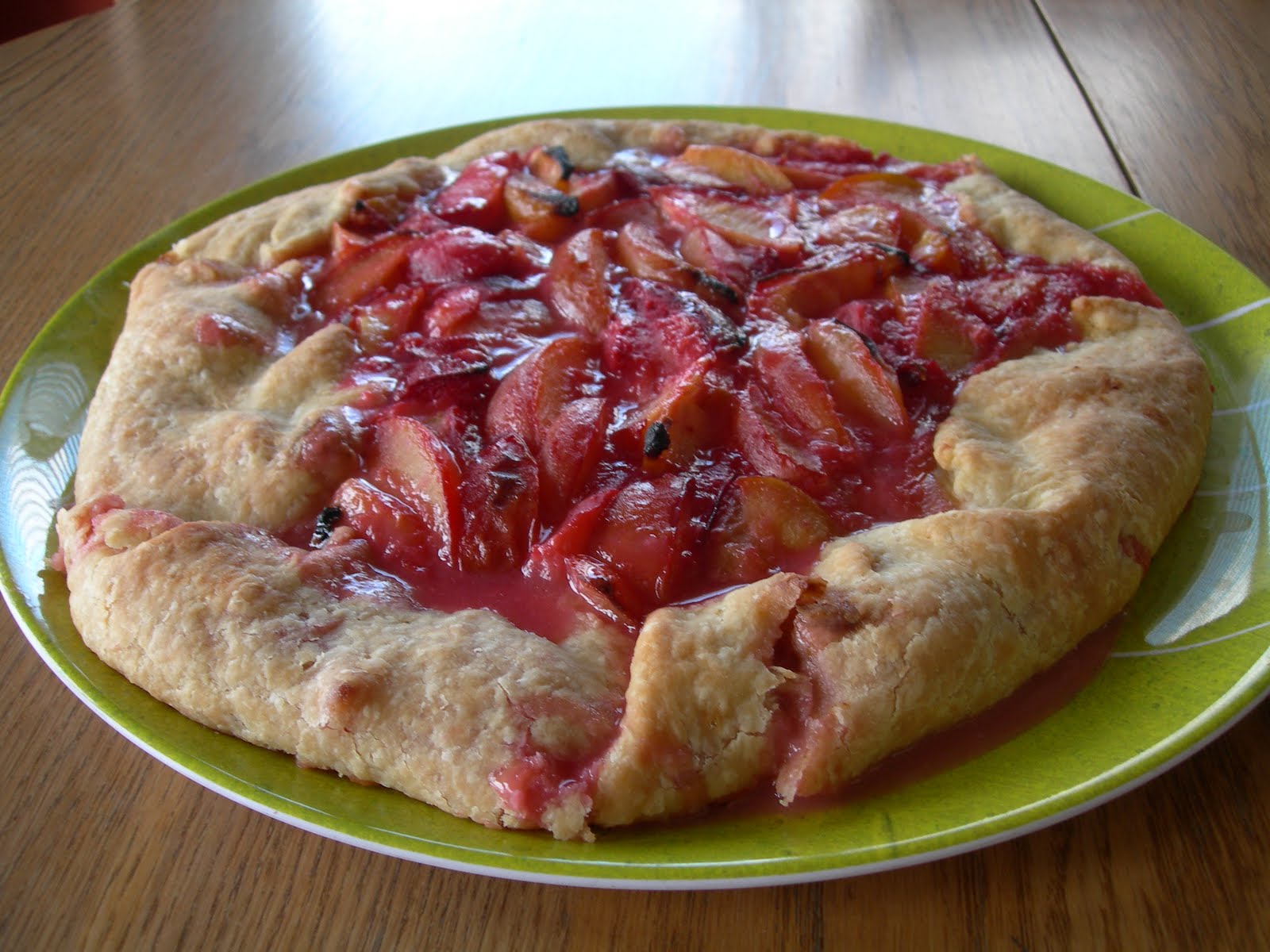
Rustic Tart of Local Plums

I admit to being somewhat beguiled by the word "rustic." I first saw it relating to edibles in a little bistro/pub in Twisp, Washington. "Rustic vegetable tart with cornmeal crust," the menu said.

The word was used to justify having just gathered the pastry up around the filling, rather than rolling it out and putting it in a pan. Well, I'm all for labor saving, and if calling something rustic gives me carte blanche to do so, I say yea!

In fact, the French have legitimized the whole process by calling these casual pies "galettes." And that's fine with me, too.
___________________________________________
RUSTIC TART OF LOCAL PLUMS

I can't remember where I found this recipe, but I've significantly altered it. The original called for sliced almonds to be stirred into the filling, Amaretto cookie crumbs (ridiculously expensive) to be scattered underneath the plums, and the pastry to be brushed with heavy cream and sprinkled with coarse brown sugar before baking. None of that, however, is necessary to produce a superb, memorable and delicious plum tart.

Pastry:
1-1/2 cups all-purpose flour
1 tablespoon sugar
1/2 teaspoon salt

7 tablespoons cold butter, cut into pieces
5 to 6 tablespoons cold water

Filling:
1/2 cup sugar (or less)
3 tablespoons all-purpose flour
1/4 teaspoon freshly ground nutmeg

2-1/2 pounds (about 8 large) not-too-ripe-or-juicy plums or pluots, pitted and cut into eighths
1 tablespoon lemon juice

Assembly:

1 egg, beaten

In food processor, combine flour, sugar and salt; pulse to mix. Add butter and pulse briefly just until coarse crumbs form. Add cold water and process in pulses until a loose ball of pastry forms. Add more water very gradually if necessary; the less you process the pastry, the flakier it will be. Gather pastry into a ball, flatten slightly, wrap in plastic, and refrigerate while you prepare the filling.

In large bowl, mix sugar, flour and nutmeg. Slice plums into a colander set over a plate. You don't want massively juicy plums for this recipe. Save the juicy ones to eat while standing over the kitchen sink!

Heat oven to 425 degrees F.

On a lightly floured board, roll out pastry to a 14-inch round. Gently fold pastry round into quarters and transfer to a baking sheet (with Silpat liner) and unfold the round. Brush the beaten egg in a circle in the center of the round, leaving about a 2-inch egg-free border.

Quickly stir plums into flour mixture, and add lemon juice. Pile plums quickly onto the center of the pastry, in the egged area (the egg seals the pastry and keeps the plum juices from softening the crust), and bring the sides of the pastry up around them.

Bake in middle of oven for 25 minutes, then check. If pastry is getting too brown, cover with aluminum foil. Bake another 15 to 20 minutes. Cool. Slice into 8 pieces and serve with creme fraiche, ice cream, or whipped cream.

Serves 8

Wednesday, September 8, 2010

Fresh Pear Sauce with White Wine and Cardamom


September has come upon us. The chill of night, the heaped cumulus clouds in the sharp blue sky of day ... and the abundance, nay, plethora, of fresh fruit lying around the kitchen. For example, the armful of pears given to me last week.

To a frugal cook, such questions as, "Can you make sauce out of pears like you can with apples?" are common. The answer to this one is, I am happy to say, most definitely yes.

I chose white wine over red to avoid the potential result of a nasty shade of pink or purple in the resulting sauce; as well, it seemed cardamom would go well with pears' more exotic taste, and indeed it does. But stealing the cinnamon from apples would do, too, if you have no cardamom.
___________________________________________
FRESH PEAR SAUCE WITH WHITE WINE AND CARDAMOM

This sauce is wonderfully fragrant and delicious; the pears' flavor mingles in a happily companionable way with the wine and cardamom. It's truly elegant enough to serve with a special meal such as roast pork, or alongside an autumnal dessert like fresh gingerbread.

About 10 fresh pears
A blub of white wine
1/2 teaspoon freshly ground cardamom seeds (I used a mortar and pestle)

Peel, core and quarter or dice the pears, and put them in a medium-sized pan or pot. Toss in the blub of white wine and the cardamom, and bring the whole thing to a simmer, cooking until the sauce reaches the texture you prefer--slightly chunky or more smooth. If you like, run a potato masher through it to even the texture.

Makes about 5 1-cup servings.